


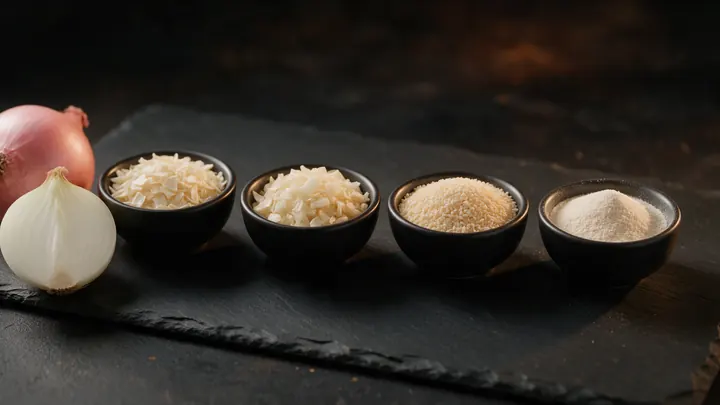
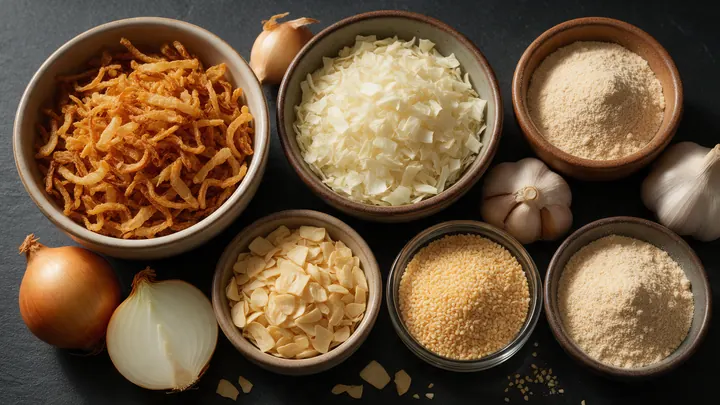






















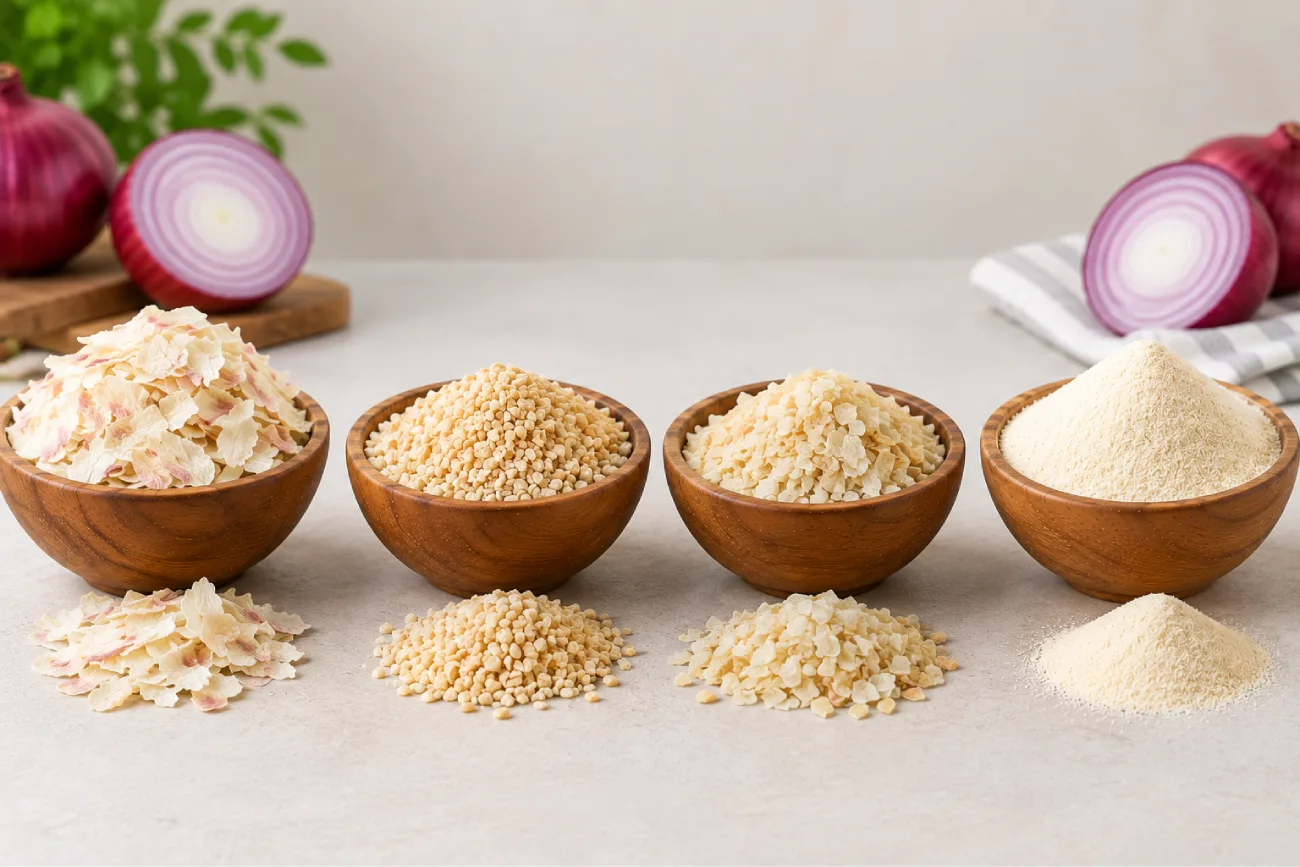
When buying dehydrated onion flakes, granules, minced onion or powder, the right choice depends mainly on your application. Each form comes from the same basic dehydrated onion but differs in particle size, texture, handling, rehydration and how evenly it blends into food products.
For businesses sourcing in bulk, working with an experienced dehydrated onion manufacturer and supplier in India can also help you select the right cut and specification for your process.
India has a strong onion-processing industry, particularly for dehydrated onion products. The final form can be produced by cutting, grading, sieving or grinding dried onion to meet specific manufacturing requirements.
What Is Dehydrated Onion?
Dehydrated onion is fresh onion from which most of the moisture has been removed through controlled drying. The dried material can then be supplied in different particle sizes, including flakes, minced pieces, granules and powder.
The basic processing route generally involves:
- Selection of suitable onions
- Cleaning and peeling
- Cutting or slicing
- Controlled dehydration
- Cooling
- Sorting and grading
- Milling or grinding when required
- Sieving and packing
The Indian Council of Agricultural Research notes that dehydrated onion can be produced as flakes and subsequently converted into powder for different food applications.
Indian food regulations also recognise dehydrated onion in forms including flakes, pieces, small grits and powder, with requirements relating to moisture, appearance, cleanliness and quality.
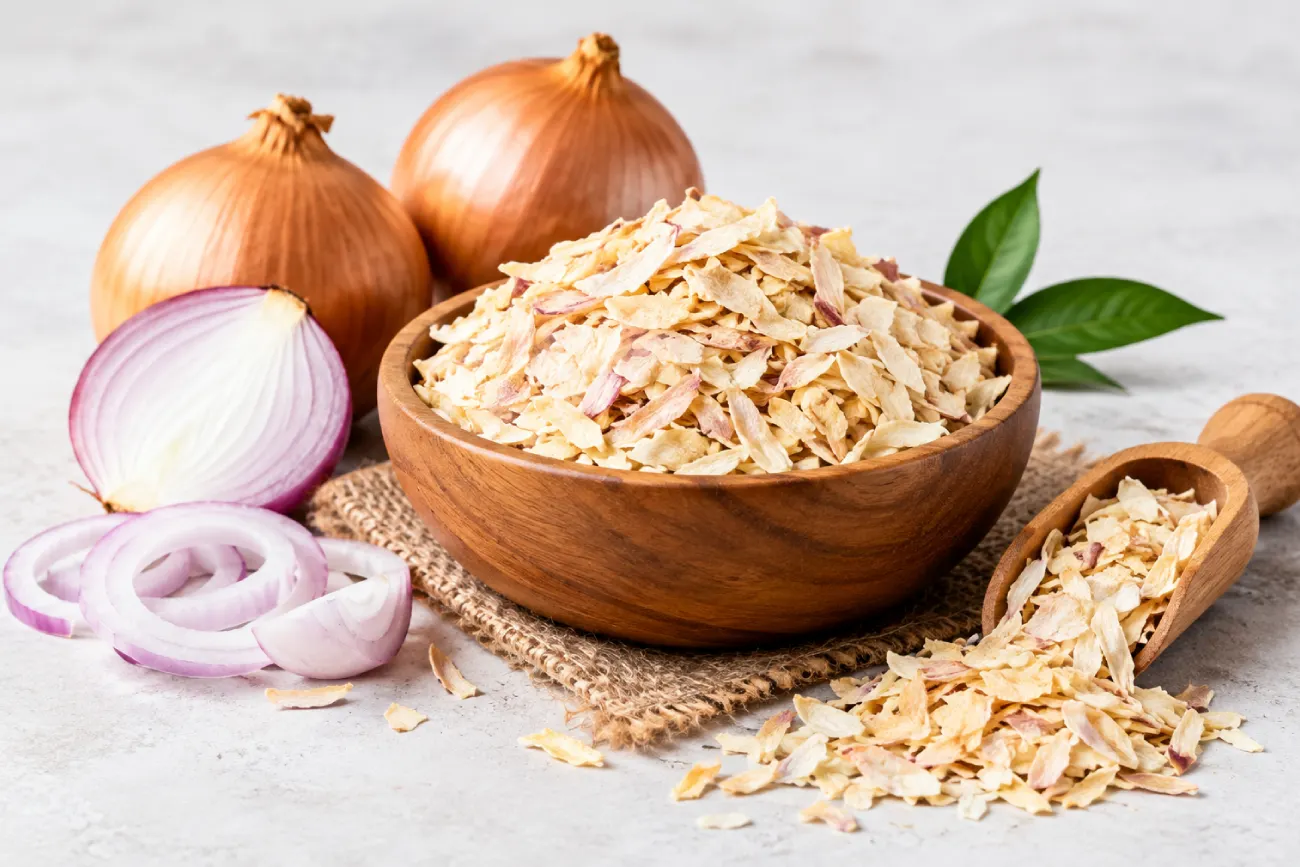
Dehydrated Onion Flakes
Dehydrated onion flakes are larger pieces of dried onion. They retain more visible structure than smaller cuts and are useful when the finished product needs noticeable onion pieces.
Common applications
Dehydrated onion flakes are commonly used in the following:
- Soups and soup mixes
- Sauces and gravies
- Ready-to-cook foods
- Seasoning blends
- Snack and namkeen products
- Instant meal preparations
- Foodservice cooking
Flakes can also be rehydrated before use. This makes them useful for manufacturers that want onion texture without handling fresh onions during production.
Why choose flakes?
The main advantage is the visible onion character. If your product needs pieces rather than an evenly distributed onion flavour, flakes are usually a better choice than powder.
Particle size is important here. A buyer should confirm the required cut size with the supplier before placing a bulk order.
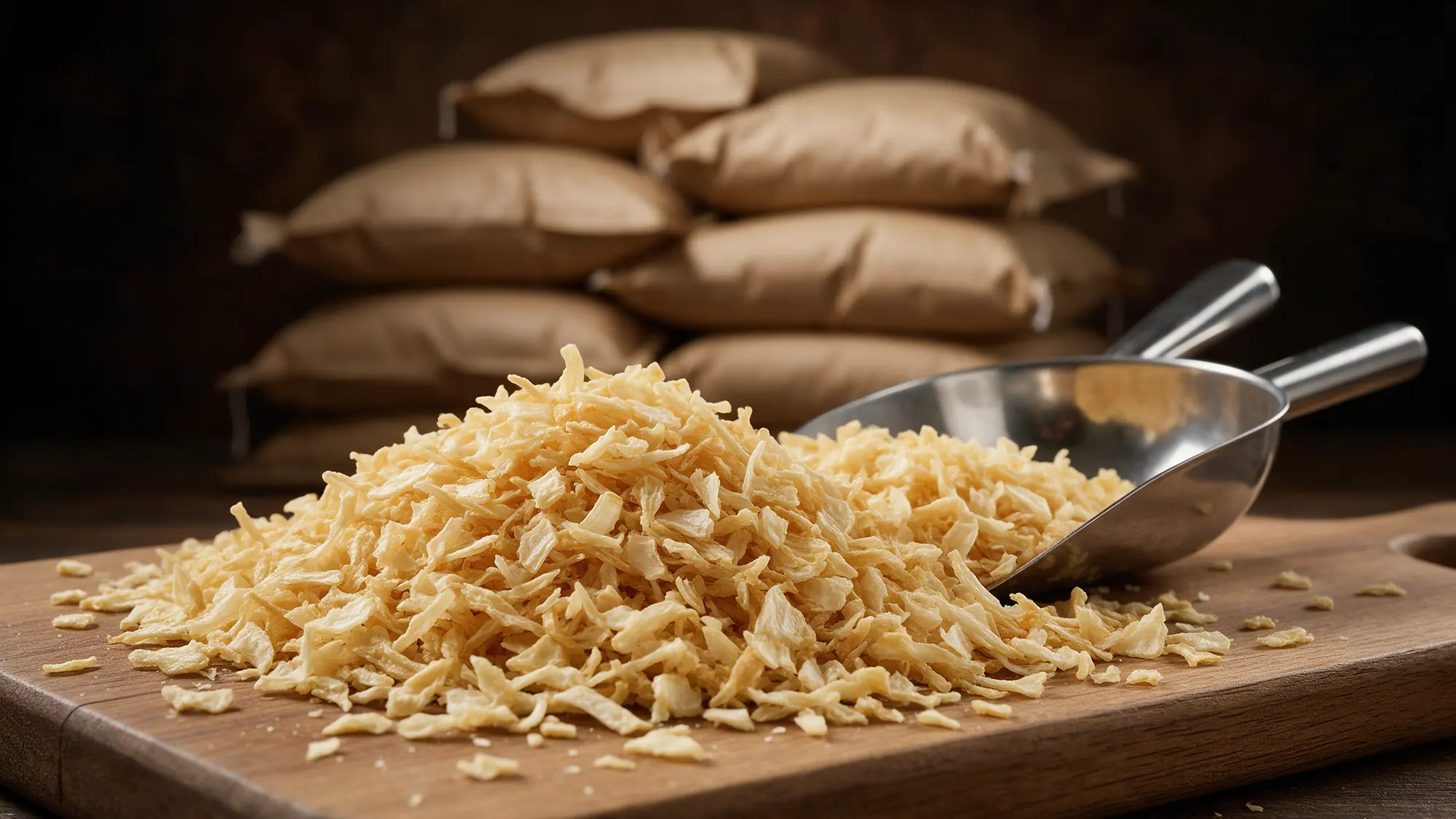
Dehydrated Onion Minced
Minced onion is smaller than traditional flakes but still retains a recognisable onion particle.
It provides a useful middle ground between larger dried pieces and fine powder.
Common applications
Minced, dehydrated onion works well in:
- Seasoning mixes
- Instant food products
- Sauces
- Marinades
- Snack coatings
- Ready-to-eat meals
- Foodservice recipes
For manufacturers, minced onion can offer more uniform distribution than large flakes while maintaining some physical texture.
It is particularly useful when the product needs onion pieces but large flakes would be too noticeable.
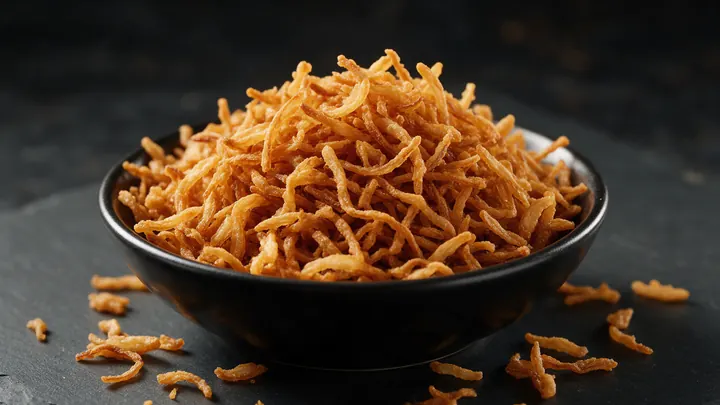
Dehydrated Onion Granules
Onion granules are smaller, more uniform particles produced through controlled milling and sieving.
They are often selected when manufacturers want consistent distribution throughout a formulation.
Common applications
Granules can be used in:
- Spice blends
- Masala products
- Snack seasonings
- Soup mixes
- Sauces
- Processed foods
- Meat and savoury formulations
One practical advantage of granules is better blending consistency. Compared with large flakes, they can distribute more evenly through dry seasoning mixes.
However, the exact granule size matters. Buyers should specify the desired particle range or mesh requirement rather than simply ordering “granules”.
Dehydrated Onion Powder
Dehydrated onion powder is the finest form among these four options. Dried onion is milled and sieved into a fine particle suitable for blending.
Common applications
Onion powder is widely suitable for:
- Spice and masala blends
- Snack seasoning
- Sauces and gravies
- Soup powders
- Instant foods
- Marinades
- Ready-to-eat products
The biggest advantage is fast and uniform distribution.
For example, a snack manufacturer may prefer onion powder when the onion flavour needs to spread evenly throughout a seasoning blend. A food manufacturer making a sauce base may also prefer powder because it integrates more easily into the formulation.
Flakes vs Minced vs Granules vs Powder
| Form | Particle Size | Texture | Best For |
| Flakes | Large | Visible pieces | Soups, ready meals, foodservice |
| Minced | Small pieces | Noticeable texture | Seasonings, sauces, instant foods |
| Granules | Uniform small particles | Fine texture | Spice blends, snacks, processed foods |
| Powder | Very fine | Smooth | Masalas, sauces, seasoning, instant mixes |
There is no single “best” form. The correct option depends on the formulation, processing equipment and desired finished-product characteristics.
How Should Food Businesses Choose the Right Form?
For bulk buyers, choosing the particle size before requesting a quotation can prevent quality and processing issues later.
Consider these five factors:
1. Final product texture
If customers should see onion pieces, choose flakes or minced onion.
If the onion should blend into the product, granules or powder may work better.
2. Mixing requirements
Dry seasoning manufacturers usually need uniform distribution. Granules and powder can be easier to incorporate into dry blends.
3. Rehydration
Larger pieces generally require different rehydration behaviour than finer particles. If your process includes rehydration, test the selected cut under actual production conditions.
4. Mesh or particle specification
Avoid purchasing only on the basis of the product name. Ask for the actual particle-size specification, moisture specification, colour requirements and other relevant quality parameters.
5. Packaging and storage
Dehydrated products need protection from moisture. USDA guidance recommends storing dry foods in cool, clean and dry conditions and protecting packaging from moisture exposure.
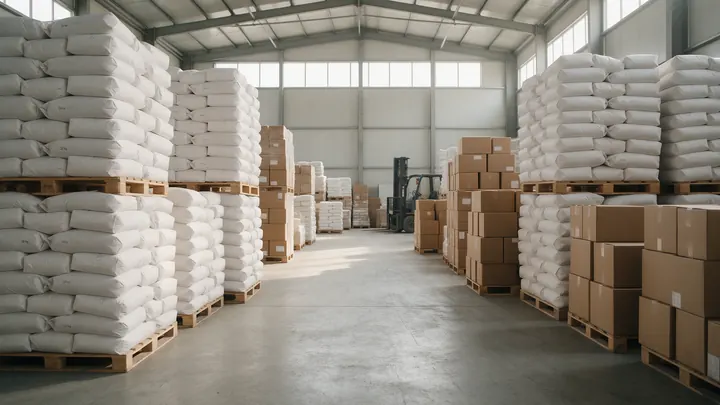
For commercial buyers, moisture-resistant food-grade packaging and intact seals are important for maintaining product quality during storage and transportation.
What Should You Ask a Dehydrated Onion Supplier?
Before placing a bulk order, ask your dehydrated onion supplier in India for clear specifications.
Important points include:
- Onion variety and origin
- Product form
- Particle or mesh size
- Moisture specification
- Colour
- Flavour and aroma
- Microbiological requirements
- Foreign-matter limits
- Packaging options
- Minimum order quantity
- Shelf-life information
- Certificate of Analysis, where applicable
- Export documentation for international orders
A reliable supplier should be able to explain how the product is processed and what specifications can be maintained from batch to batch.
Why Particle Size Matters in Bulk Manufacturing
Particle size is not simply a matter of appearance. It can influence mixing, dosing, rehydration, flavour distribution and the final texture of the product.
For example:
- Flakes → better when visible onion pieces are required.
- Minced → suitable for smaller pieces with some texture.
- Granules → useful for controlled distribution in dry blends.
- Powder → preferred when smooth and uniform incorporation is required.
This is why food manufacturers should select the product according to the production process rather than choosing only on price.
Choosing a Dehydrated Onion Manufacturer in India
When comparing a dehydrated onion manufacturer in India, look beyond the quoted price per kilogram.
Check whether the manufacturer can provide:
- Consistent particle sizing
- Controlled dehydration
- Hygienic processing
- Suitable food-grade packaging
- Batch-level quality checks
- Required documentation
- Export support
- Custom specifications where available
Optimum Foods states that its dehydrated onion range is available in flakes, granules, minced and powder forms, with controlled processing, sorting, grinding and moisture-resistant packaging for bulk applications.
For B2B buyers, this kind of specification-based sourcing is more useful than selecting a supplier based only on product photographs or a basic catalogue description.
Final Takeaway
Flakes, minced onion, granules and powder are different forms of the same basic dehydrated onion, but each serves a different manufacturing purpose.
Choose flakes when visible pieces and texture matter. Choose minced for smaller onion pieces, granules for consistent distribution and powder when smooth blending and uniform flavour are the priority.
For bulk procurement, always confirm particle size, moisture, quality specifications, packaging and application suitability before ordering. A dependable supplier should be able to match the product form with your production requirements.
Optimum Foods supplies dehydrated onion products for food manufacturers, snack brands, spice companies, HoReCa businesses, distributors and international buyers seeking consistent bulk ingredients.
Frequently asked questions
What are dehydrated onion flakes used for?
Dehydrated onion flakes are used in soups, sauces, ready-to-eat meals, seasoning mixes and foodservice cooking. They provide visible onion pieces and can be rehydrated when required. They are especially useful for manufacturers that want onion texture without the preparation, peeling and storage challenges associated with fresh onions.
What is the difference between dehydrated onion flakes and granules?
The main difference is particle size. Flakes are larger, visible pieces, while granules are smaller and more uniform. Flakes are generally preferred when texture matters, whereas granules are useful for seasoning blends, snacks and processed foods where consistent distribution throughout the formulation is important.
Is minced dehydrated onion better than onion powder?
Neither is universally better. Minced dehydrated onion retains more physical texture, while onion powder blends more easily into formulations. Minced onion works well when small onion pieces are desirable. Powder is generally more suitable for sauces, masalas, seasonings and products requiring uniform onion flavour.
How do I choose a dehydrated onion supplier in India?
Compare suppliers based on product consistency, particle-size control, moisture specifications, hygiene practices, packaging, documentation, testing and supply capability. For bulk purchases, request a product specification or sample before finalizing an order. This helps confirm that the material suits your actual manufacturing process.
What specifications should I check when buying dehydrated onion?
Important specifications include product form, particle size or mesh, moisture, colour, flavour, aroma, microbiological requirements, foreign matter and packaging. Depending on your application, you may also need rehydration performance, allergen information, certificates of analysis and export documentation.
Can dehydrated onion flakes be converted into powder?
Yes. Dehydrated onion flakes can be further processed through suitable grinding and sieving equipment to produce onion powder. Industrial processors can control the final particle size according to the required specification. The powder should then be packed properly to protect it from moisture and maintain quality.