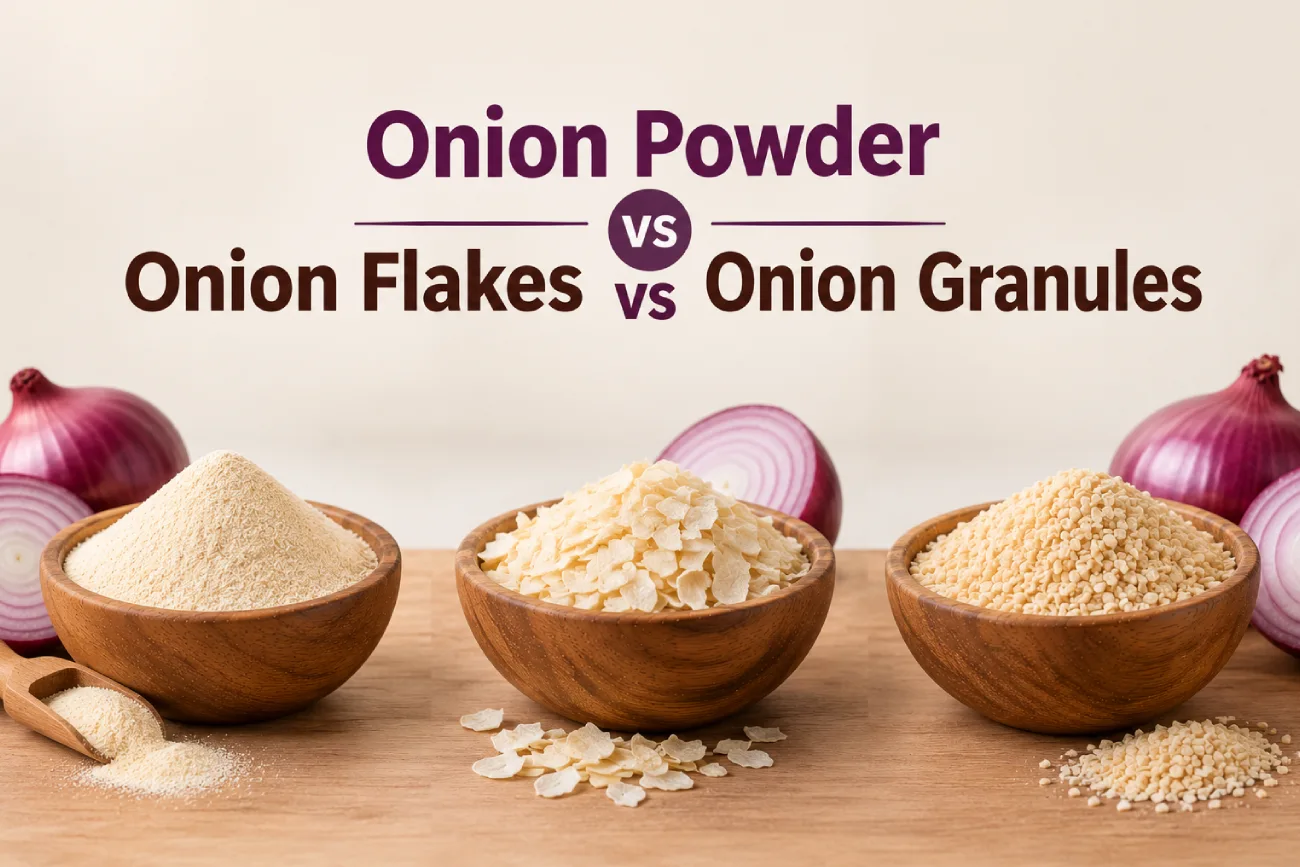
Onion Powder vs Onion Flakes vs Onion Granules is an important comparison for businesses that buy dehydrated onion ingredients in bulk. Although all three products come from dehydrated onions, their size, texture, flavor release and applications can be quite different.
For food manufacturers and bulk buyers, choosing the right form starts with understanding how each product performs. You can also explore specifications and product options from dehydrated onion suppliers in India before selecting a product for commercial production.
Whether you manufacture snacks, spice blends, sauces, ready-to-eat foods, or prepared meals, the right onion format can improve processing efficiency and product consistency.
What Are Onion Powder, Flakes and Granules?
All three products are generally made by cleaning, slicing, drying or dehydrating onions, followed by processing them into different particle sizes.
The key difference is particle size and form.
Onion Powder
Onion Powder is a finely ground form of dehydrated onion. Its small particle size allows it to disperse easily throughout a food mixture.
It is commonly used when manufacturers want onion flavor without visible onion pieces.
Onion Flakes
Onion Flakes are larger, thin pieces of dehydrated onion. They retain more of the original onion structure than powder.
They can provide both onion flavor and visible texture in certain recipes.
Onion Granules
Onion Granules are small, coarse particles that sit between flakes and powder in size.
They offer a useful balance between controlled distribution and noticeable onion texture.
Onion Powder vs Onion Flakes vs Onion Granules: Main Differences
The simplest way to compare these products is by looking at their physical characteristics and typical applications.
| Feature | Onion Powder | Onion Flakes | Onion Granules |
| Particle size | Very fine | Larger pieces | Medium/coarse |
| Texture | Smooth | Visible pieces | Coarse |
| Flavor distribution | Very fast and even | Gradual | Even and controlled |
| Visible onion pieces | No | Yes | Sometimes |
| Best suited for | Seasonings, sauces, blends | Foods needing texture | Seasonings and processed foods |
| Mixing | Very easy | Requires more mixing | Easy |
| Hydration | Fast | Slower | Moderate |
| Processing flexibility | High | High | High |
The ideal option depends on your recipe, production process and desired final texture.
1. Onion Powder: Best for Even Flavor Distribution
Onion Powder is often the most convenient option when a manufacturer wants onion flavor throughout a product.
Because the particles are very fine, the powder can mix efficiently with dry ingredients and liquid formulations.
Common applications
- Spice and seasoning blends
- Snack coatings
- Sauces and gravies
- Soups
- Instant food products
- Marinades
- Processed meat products
- Ready-to-eat foods
For spice and masala manufacturers, powder can be especially useful because it blends easily with other powdered ingredients.
However, particle size matters. Very fine powder can behave differently during mixing, handling and packaging than a coarser product. Buyers should therefore confirm mesh or particle-size specifications before ordering.
2. Onion Flakes: Best When Texture Matters
Onion Flakes preserve a more recognizable onion structure.
They are useful when the final product benefits from visible pieces or a more natural-looking onion ingredient.
Common applications
- Soups
- Instant meals
- Sauces
- Seasoned vegetables
- Snack mixes
- Ready-to-cook products
- Foodservice preparations
Flakes may also be useful where the manufacturer wants the onion to hydrate during cooking.
For commercial production, consistency in flake size can matter because uneven pieces may hydrate or cook at different rates.
3. Onion Granules: A Middle Ground
Onion Granules provide a practical middle option between powder and flakes.
They are coarse enough to offer more structure than powder but small enough to distribute efficiently through many food formulations.
Common applications
- Seasoning blends
- Snack manufacturing
- Meat and poultry products
- Sauces
- Instant foods
- Dry mixes
- Marinades
Granules can be useful when a manufacturer wants onion flavor with some particle presence but does not want large pieces.
How Does Particle Size Affect Food Production?
Particle size influences more than appearance.
It can affect:
- Mixing uniformity
- Hydration speed
- Flavor release
- Flowability
- Distribution within a product
- Packaging behavior
- Final texture
For example, powder can distribute rapidly through a dry seasoning mix, while flakes may remain more visible.
This is why B2B buyers should not select a dehydrated onion product only by price. The product should be tested in the actual formulation.
Which Onion Form Is Best for Your Business?
For Spice & Masala Manufacturers
Onion Powder is usually the most practical choice when the product needs uniform blending.
It can be mixed with spices and seasonings without creating large visible pieces.
For Snack & Namkeen Manufacturers
Powder and granules can both work well depending on the seasoning system.
Powder is useful for even coverage, while granules can provide a slightly different texture and flavor release.
For Food Manufacturers
The choice depends on the final product.
Use flakes when visible onion pieces are desirable. Choose granules when controlled particle presence is needed. Use powder when uniform flavor distribution is the priority.
For Hotels, Restaurants & Caterers
Flakes and powder can help reduce some of the preparation involved in handling fresh onions, depending on the recipe.
The right form depends on whether the kitchen needs visible pieces, seasoning, or an ingredient for sauces and gravies.
For Ready-to-Eat Food Brands
Flakes can work well in products where the consumer expects visible ingredients, while powder can be useful in sauces, seasoning systems and blended formulations.
What Should Bulk Buyers Check Before Ordering?
Choosing reliable dehydrated onion suppliers requires more than comparing quotations.
Before placing a bulk order, ask for:
- Particle-size or mesh specification
- Moisture specification
- Color and appearance requirements
- Raw material information
- Packaging details
- Shelf-life information
- Food safety certifications
- Batch traceability
- Sample for testing
- Minimum order quantity
- Production capacity
- Delivery lead time
For international buyers, documentation and export packaging should also be discussed before confirming an order.
A good supplier should be transparent about specifications and able to provide consistent batches. Product samples should ideally be tested in your own production process rather than evaluated only visually.
How Are Dehydrated Onion Products Stored?
Regardless of whether you purchase powder, flakes, or granules, moisture control is important.
Products should be stored in clean, dry conditions and protected from moisture. Once packaging is opened, proper resealing becomes especially important.
The U.S. Department of Agriculture’s Food Safety (USDA) and Inspection Service recommends keeping dry foods protected from moisture and stored under suitable conditions to maintain quality. This is particularly relevant for dehydrated ingredients used in commercial food production.
For bulk storage, always follow the manufacturer’s recommended temperature, humidity, packaging and handling conditions.
Onion Powder vs Onion Flakes vs Onion Granules: Final Verdict
There is no single winner in the Onion Powder vs Onion Flakes vs Onion Granules comparison.
Each form serves a different purpose:
- Choose Onion Powder for smooth mixing and uniform flavor distribution.
- Choose Onion Flakes when visible onion pieces and texture are important.
- Choose Onion Granules when you need a balance between distribution and particle presence.
For B2B buyers, the best product is the one that performs consistently in the final formulation.
Before committing to a large purchase, request a sample, confirm specifications, test it in production and evaluate the supplier’s ability to maintain consistent quality from batch to batch.
Optimum Foods supplies dehydrated onion products for food manufacturers, spice brands, HoReCa businesses, distributors and bulk buyers, with a focus on consistent processing, food-grade quality and reliable supply.
FAQs
- What is the difference between Onion Powder, Onion Flakes and Onion Granules?
Onion Powder is finely ground dehydrated onion, while Onion Flakes are larger pieces that retain more onion structure. Onion Granules are coarser than powder but smaller than typical flakes. The main differences are particle size, texture, mixing behavior, hydration speed and how the ingredient performs in different food applications.
- Which is better for spice and masala manufacturing: Onion Powder or Granules?
Onion Powder is generally suitable for spice and masala manufacturing when uniform flavor distribution and smooth blending are important. Onion Granules can be useful when manufacturers want more particle presence. The final choice should depend on the formulation, desired texture, processing method and required particle-size specification.
- Are Onion Flakes suitable for ready-to-eat food products?
Yes, Onion Flakes can be suitable for ready-to-eat foods where visible onion pieces and texture are desirable. They can be used in soups, sauces, instant meals, snack mixes and other prepared foods. Their performance depends on the product formulation, hydration conditions, cooking process and required final texture.
- How do I choose dehydrated onion suppliers for bulk orders?
When choosing dehydrated onion suppliers, check product specifications, particle size, moisture, color, packaging, certifications, batch consistency, MOQ, production capacity and delivery timelines. Requesting samples and testing them in your actual formulation is also important. A reliable supplier should provide clear specifications and consistent quality across production batches.
- Is Onion Powder better than Onion Flakes for snack manufacturing?
It depends on the snack and seasoning system. Onion Powder works well when manufacturers need fine, even distribution across a seasoning blend or coating. Onion Flakes are better when visible onion pieces are part of the desired product. Granules can provide an alternative where a coarser onion component is preferred.
- What should I check when buying onion powder in bulk?
Bulk buyers should check particle size or mesh, moisture, colour, flavor, purity, packaging, shelf life, food safety documentation and batch consistency. It is also useful to request a product sample before confirming a larger order. The powder should perform consistently in the buyer’s intended food application and processing conditions.