Dehydrated onions have become an essential ingredient for modern food manufacturing because they provide convenience, consistent quality and a long shelf life. They are widely used in snacks, spice blends, instant foods, sauces, seasonings, ready-to-eat meals and food service operations. Compared to fresh onions, dehydrated onions reduce preparation time, minimize waste and simplify inventory management.
If you are looking for a reliable dehydrated onion manufacturer in India, understanding the different types, manufacturing processes, storage practices and commercial applications will help you select the right product for your business.
What Are Dehydrated Onions?
Dehydrated onions are fresh onions that have most of their natural moisture removed through a controlled drying process. Removing moisture helps extend shelf life while preserving the onion’s characteristic flavor and aroma.
Unlike fresh onions, dehydrated products are lightweight, easy to transport and ready to use in commercial food production.
They are commonly supplied in different particle sizes to meet various industrial applications.
Types of Dehydrated Onions
Different industries require different onion cuts depending on the final product.
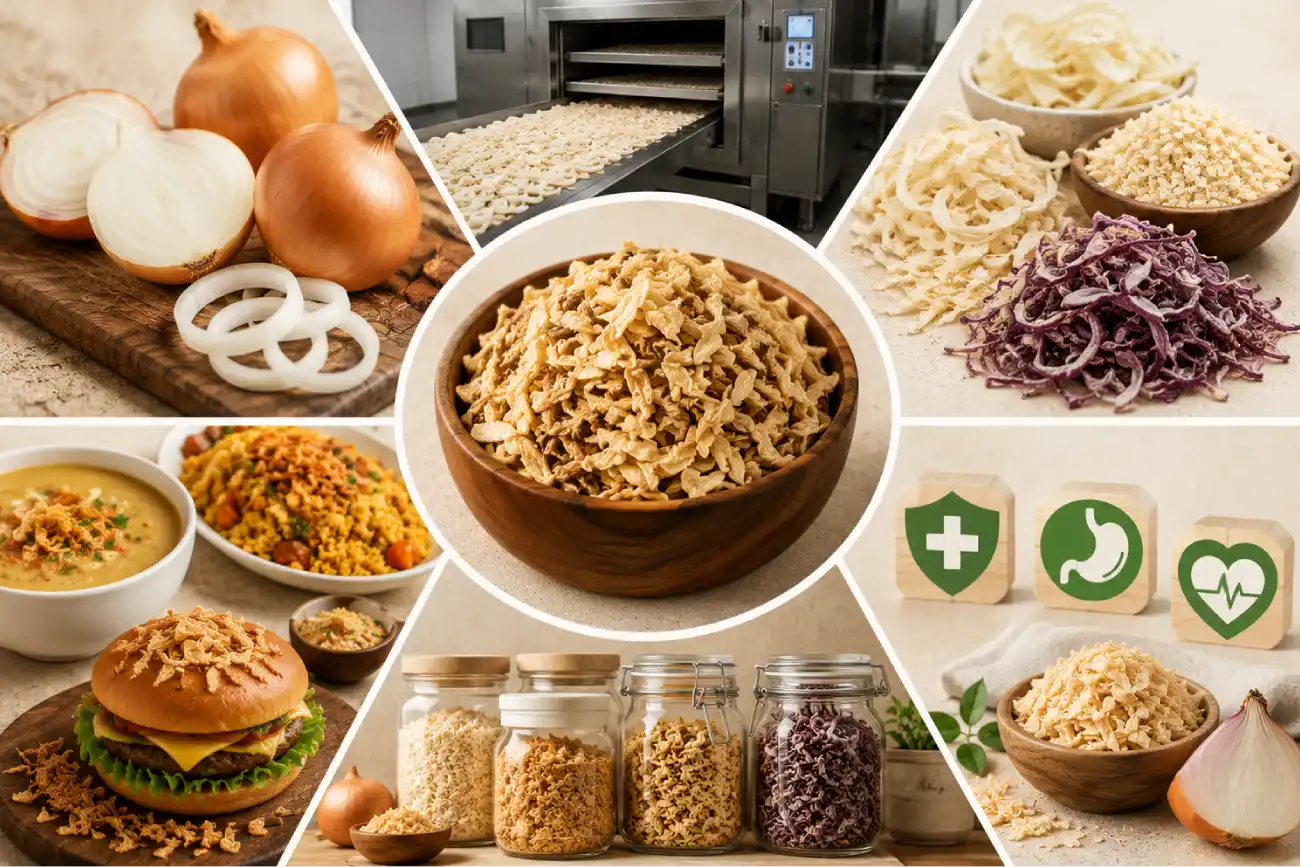
Dehydrated Onion Flakes
Flakes are larger onion pieces commonly used in:
- Instant soups
- Ready meals
- Frozen foods
- Sauces
- Curry mixes
They provide visible onion pieces after rehydration and retain a natural appearance.
Dehydrated Onion Minced
Minced onions are smaller than flakes and are suitable for:
- Processed foods
- Meat products
- Seasoning mixes
- Ready-to-cook products
They distribute evenly throughout recipes.
Dehydrated Onion Granules
Granules provide a balanced texture between minced onions and powder.
They are widely used in:
- Spice blends
- Dry rubs
- Snack seasonings
- Instant mixes
Dehydrated Onion Powder
Onion powder is finely ground and dissolves easily into food formulations.
It is ideal for:
- Sauces
- Dressings
- Marinades
- Spice mixes
- Bakery products
- Ready-to-eat foods
How Dehydrated Onions Are Manufactured
High-quality dehydrated onions begin with carefully selected fresh onions.
A typical manufacturing process includes:
Raw Material Selection
Fresh onions are selected based on size, maturity and overall quality.
Only suitable onions are used for processing to ensure consistent results.
Cleaning and Peeling
The onions are thoroughly washed to remove soil and impurities before peeling.
Proper cleaning supports hygienic food production.
Cutting
Depending on customer requirements, onions are cut into flakes, minced pieces, or granules, or prepared for powder production.
Uniform cutting helps achieve consistent drying.
Controlled Dehydration
The onions are dried using controlled temperatures to remove moisture while preserving flavor, color and aroma.
Proper dehydration improves shelf life without compromising product quality.
Quality Inspection
Every batch undergoes quality checks for:
- Moisture level
- Color consistency
- Particle size
- Cleanliness
- Packaging quality
Reliable dehydrated onion manufacturers follow standardized quality procedures throughout the production process.
Benefits of Dehydrated Onions
Commercial food businesses choose dehydrated onions for several practical reasons.
Longer Shelf Life
Low moisture content allows products to remain stable for extended periods when stored correctly.
Reduced Food Waste
Unlike fresh onions, dehydrated products experience minimal spoilage during storage.
Convenient Storage
They require less storage space and are easier to transport because of their reduced weight.
Consistent Quality
Every production batch delivers reliable flavor, appearance and performance.
Labor Savings
Using dehydrated onions eliminates peeling, slicing and preparation, reducing labor costs in commercial kitchens and manufacturing facilities.
Common Applications
Dehydrated onions are widely used across the food industry.
Food Manufacturers
Ready-to-eat meals, frozen foods, processed foods, sauces and instant products.
Snack & Namkeen Manufacturers
Seasoning blends, coatings and flavoring applications.
Spice & Masala Brands
Dry spice mixes, curry powders, seasoning blends and marinades.
Hotels, Restaurants & Caterers (HoReCa)
Soups, gravies, sauces, biryani, curries and large-scale food preparation.
Exporters & International Importers
Long shelf life and lightweight packaging make dehydrated onions suitable for global distribution.
Distributors & Bulk Traders
Stable quality supports inventory management and customer satisfaction.
Best Storage Practices
Proper storage helps maintain quality throughout the product’s shelf life.
Follow these recommendations:
- Store in a cool, dry place.
- Keep products away from direct sunlight.
- Use airtight, moisture-resistant packaging.
- Seal opened containers immediately.
- Follow the First In, First Out (FIFO) inventory method.
Proper storage preserves flavor, texture and product performance.
How to Choose the Right Supplier
Choosing the right supplier is critical for consistent food production.
When evaluating dehydrated onion suppliers in India, consider the following:
- Manufacturing experience
- Quality control systems
- Food safety practices
- Product consistency
- Packaging standards
- Production capacity
- Delivery reliability
- Export capabilities
A trusted supplier should provide detailed product specifications and maintain consistent quality across every batch.
Food Safety and Quality Standards
Food manufacturers should source ingredients from suppliers that follow recognized food safety systems.
According to the U.S. Food and Drug Administration (FDA), Good Manufacturing Practices (GMP) help ensure food products are consistently produced, processed and packed under hygienic conditions.
Working with suppliers that follow established quality standards helps protect product integrity and customer confidence.
Why Premium Quality Matters
Selecting premium dehydrated onion products offers several advantages:
- Better flavor retention
- Consistent particle size
- Lower moisture levels
- Improved shelf life
- Reliable production performance
- Reduced waste
- Better customer satisfaction
These benefits make premium products the preferred choice for commercial food businesses.
Why Choose Us?
At Optimum Foods, we manufacture premium dehydrated onions using carefully selected fresh onions, advanced dehydration technology and strict quality control procedures. Our products are available in flakes, minced form, granules and powder to meet the needs of food manufacturers, spice brands, HoReCa businesses, exporters, distributors and bulk traders.
With a strong focus on consistent quality, hygienic processing, dependable supply and customer satisfaction, we help businesses across India and international markets source dehydrated onions they can rely on.
Frequently Asked Questions
- What are Dehydrated Onions?
Dehydrated onions are fresh onions that have most of their moisture removed through a controlled drying process. They offer a longer shelf life, convenient storage and consistent quality, making them ideal for commercial food manufacturing and food service applications.
- What are the different types of Dehydrated Onions?
Dehydrated onions are available as flakes, minced, granules and powder. Each type is suitable for different food applications, including seasoning blends, soups, sauces, snacks, ready meals and processed food products.
- How should dehydrated onions be stored?
Store dehydrated onions in airtight, moisture-resistant packaging in a cool, dry place away from sunlight. Proper storage helps preserve flavor, texture and shelf life while reducing the risk of moisture absorption.
- How do I choose reliable dehydrated onion suppliers in India?
Choose suppliers with modern manufacturing facilities, strict quality control, hygienic production practices, reliable packaging and experience serving food manufacturers, exporters and bulk buyers with consistent product quality.
- Why do food manufacturers use premium dehydrated onion?
Premium dehydrated onion provides consistent flavor, uniform particle size, lower moisture levels, reliable shelf life and reduced preparation time, making it an efficient ingredient for large-scale food production.
- Are dehydrated onions suitable for export?
Yes. Dehydrated onions are widely exported because they are lightweight, have a long shelf life, require minimal storage space and can be packed securely for international transportation.