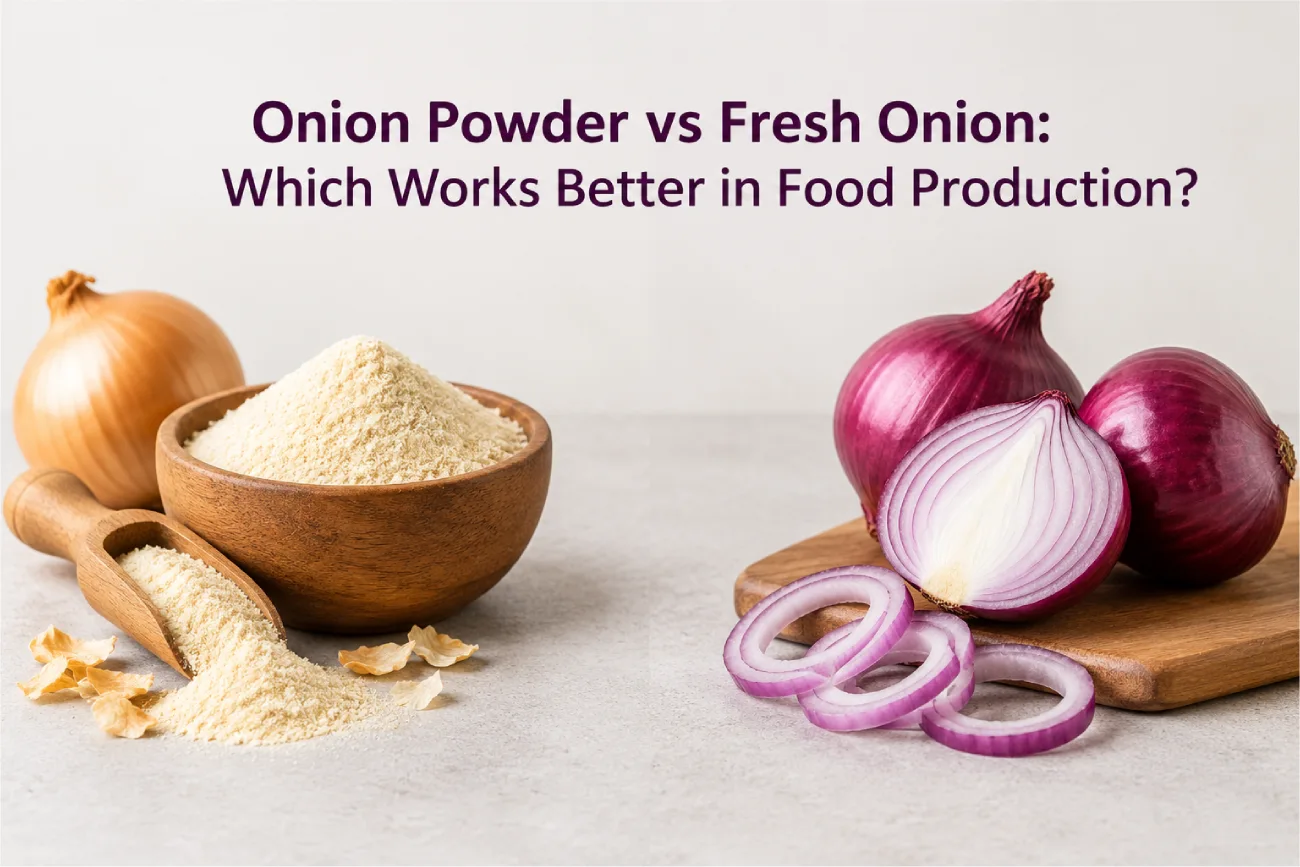
Onion powder vs fresh onion is an important comparison for food manufacturers choosing ingredients for consistent production. Both provide onion flavour, but they behave differently in preparation, storage, handling, dosage and manufacturing.
Fresh onions can work well when a product requires visible onion pieces or freshly prepared ingredients. Onion powder is more suitable when manufacturers need a dry, consistent ingredient that can be measured and blended easily. Businesses sourcing in bulk can also work with an experienced onion powder manufacturer in India to discuss specifications and application requirements.
What Is Onion Powder?
Onion powder is produced by processing onions and reducing their moisture before milling the dried material into a fine powder.
The manufacturing process generally involves selecting suitable onions, cleaning and preparing the raw material, controlled drying, milling and sieving. The final product is then packed according to its intended application and storage requirements.
The exact processing method and specifications can vary between manufacturers. For commercial buyers, it is therefore important to evaluate the actual product specification rather than assuming that every onion powder will perform in the same way.
Onion Powder vs Fresh Onion: Key Differences
The biggest difference is how each ingredient behaves during food production.
| Factor | Onion Powder | Fresh Onion |
| Preparation | Ready to measure and blend | Requires cleaning, peeling and cutting |
| Moisture | Low-moisture ingredient | High-moisture ingredient |
| Storage | Generally easier to handle as a dry ingredient | Requires more controlled storage |
| Consistency | Easier to standardize by weight | Can vary with size and moisture |
| Processing | No chopping required at production stage | Requires preparation before use |
| Distribution | Convenient for dry ingredient supply | More sensitive to handling |
| Applications | Seasonings, sauces, snacks, mixes | Foods requiring fresh onion pieces or texture |
The better choice depends on the product being manufactured, production method, equipment, storage conditions and desired finished-food characteristics.
1. Production Efficiency
For large-scale food production, preparation time can have a direct effect on workflow.
Fresh onions need to be received, stored, peeled, trimmed, washed where required and cut before entering many production processes. This creates additional handling steps.
Onion powder can be weighed and added directly to many dry or liquid formulations. This makes it useful for seasoning blends, snack coatings, sauces, instant mixes and other standardized formulations.
For manufacturers producing the same recipe repeatedly, a dry ingredient can also simplify batching and measurement.
2. Consistency and Dosage
Consistency is one of the main reasons manufacturers consider onion powder.
Fresh onions naturally vary in size, moisture, maturity and pungency. These variations can affect the amount of onion solids introduced into a formulation.
A properly specified onion powder provides a more standardized dry ingredient. Manufacturers can establish a defined dosage based on their recipe and product specifications.
However, consistency still depends on supplier controls. Buyers should check parameters such as particle size, moisture, colour, flavour profile, purity and packaging before selecting a supplier.
3. Shelf Life and Storage
Storage is another major difference.
Fresh onions contain substantially more moisture and require appropriate storage conditions to maintain quality. USDA guidance lists dry onions among produce items suitable for dry storage rather than refrigeration.
Onion powder is a low-moisture ingredient, but that does not mean it can be stored without controls. Exposure to humidity can cause clumping, quality deterioration and packaging problems.
For dry ingredients, USDA guidance recommends protecting products from dampness and checking packaging for holes or damage.
For commercial production, onion powder should therefore be kept in properly sealed packaging in a clean, dry storage environment.
4. Packaging Requirements
Packaging has a direct role in maintaining the quality of onion powder.
A suitable package should help protect the product from moisture, contamination and physical damage during storage and transportation.
When buying in bulk, manufacturers should discuss:
- Packaging material
- Bag or container size
- Inner liner requirements
- Sealing method
- Labelling
- Batch identification
- Storage instructions
- Domestic or export transportation requirements
FDA food-safety guidance also recognizes that food packaging and food-contact materials must be suitable for their intended use.
5. Food Applications
Fresh onion and onion powder can serve different purposes in food manufacturing.
Onion powder is commonly useful for:
- Spice and seasoning blends
- Snack and namkeen seasonings
- Sauces and gravies
- Instant food mixes
- Ready-to-eat products
- Ready-to-cook formulations
- Marinades
- Processed food products
Fresh onion is often preferred when the finished product needs visible onion pieces, fresh texture, or characteristics associated with freshly prepared vegetables.
The choice should therefore be based on the role onion plays in the final product, rather than treating one ingredient as universally better.
6. Quality Specifications to Check
When purchasing onion powder for commercial production, buyers should request a clear product specification.
Depending on the application, relevant parameters may include:
- Moisture
- Particle size or mesh
- Colour
- Aroma and flavour
- Purity
- Foreign matter limits
- Microbiological requirements
- Packaging
- Shelf-life information
A supplier should be able to explain which specifications are controlled and how batches are evaluated.
Food manufacturers also need to consider food-safety controls throughout processing. FDA guidance notes that manufacturers have a responsibility to minimize or prevent food hazards and ensure the safety of ingredients and processing practices.
7. Bulk Buying: What Should Manufacturers Consider?
For bulk buyers, purchasing decisions should go beyond price per kilogram.
Before placing an order, compare the supplier’s:
- Product specification
- Sample quality
- Batch consistency
- MOQ
- Packaging options
- Production capacity
- Quality-control procedures
- Documentation
- Delivery capability
- Export requirements, where applicable
Testing a sample in your own formulation is especially useful. Onion powder that performs well in one application may require a different particle size, flavour profile, or dosage in another.
8. Onion Powder Manufacturer vs Supplier
When selecting an Onion Powder Supplier in India, buyers should understand whether they are purchasing directly from a manufacturer or through a trading channel.
A direct manufacturer may be able to provide greater visibility into production, specifications, batch controls, packaging and customization requirements. However, the right supplier should ultimately be evaluated according to the buyer’s actual requirements and quality expectations.
For international buyers, additional factors such as export packaging, documentation, shipment planning and destination-market requirements should also be discussed before placing an order.
Which One Should Food Manufacturers Choose?
There is no single answer for every food product.
Choose onion powder when you need:
- Easy measurement
- A dry ingredient
- Consistent formulation
- Simple handling
- Convenient storage
- Efficient blending
- Reduced preparation steps
Consider fresh onion when you need:
- Visible onion pieces
- Fresh texture
- Fresh onion characteristics
- A formulation where the onion itself is a major physical component
For many processed food applications, the practical question is not whether onion powder is universally better than fresh onion. It is whether the ingredient fits the manufacturing process and finished-product requirements.
Final Thoughts
The choice between onion powder and fresh onion should be based on production requirements, formulation, storage, consistency and the role of onion in the finished product.
For manufacturers, onion powder can simplify handling, measurement, dry blending and storage. Fresh onion remains useful when texture, appearance and fresh characteristics are important.
Before buying in bulk, request a product specification, evaluate a sample, check packaging and storage requirements and confirm that the supplier can maintain consistent quality across repeat orders.
Optimum Foods supplies dehydrated food ingredients for food manufacturers, snack and namkeen brands, spice companies, HoReCa businesses, distributors and international buyers, with attention to product specifications, packaging, consistency and bulk supply requirements.
FAQs
- Is onion powder better than fresh onion for food manufacturing?
Onion powder can be more convenient for food manufacturing when consistent dosing, dry blending, storage and reduced preparation are important. Fresh onion may be more suitable when the finished product requires visible pieces or fresh texture. The appropriate choice depends on the formulation, processing method and final product requirements.
- What are the advantages of onion powder over fresh onion?
Onion powder offers convenient handling, easy measurement, dry storage and consistent incorporation into many formulations. It can reduce preparation steps such as peeling and chopping. It is commonly useful for seasoning blends, snacks, sauces, instant mixes and processed foods where visible onion pieces are not required.
- How should onion powder be stored for better shelf life?
Onion powder should generally be stored in sealed, suitable packaging in a clean, cool and dry environment. Protecting it from moisture is important because humidity can cause caking and affect quality. Buyers should always follow the manufacturer’s storage instructions and product-specific shelf-life recommendations.
- What quality specifications should buyers check for onion powder?
Bulk buyers should review specifications such as moisture, particle size or mesh, colour, aroma, flavour, purity, foreign matter limits, microbiological requirements, packaging and shelf life. Requirements can vary by application, so manufacturers should agree on specifications with their Onion Powder Supplier before placing a large order.
- How do I choose an Onion Powder Manufacturer in India?
Compare manufacturers based on product specifications, sample quality, production capacity, quality-control systems, batch consistency, packaging, MOQ, documentation and supply capability. For export orders, also discuss packaging, documentation, shipment requirements and destination-market specifications before finalizing the supplier.
- Can onion powder be used in snack and seasoning manufacturing?
Yes. Onion powder is commonly suitable for dry seasoning blends and formulations used in snacks, namkeen, sauces, instant foods and other processed products. Its particle size, flavour strength, moisture and purity should match the formulation so that the finished product receives the desired onion characteristics.
- Is onion powder suitable for export and international bulk buying?
Onion powder can be supplied for international bulk markets, but buyers should confirm product specifications, packaging, documentation, food-safety requirements, shelf life and destination-country requirements. An export order should be evaluated against the buyer’s technical specification rather than relying only on a general product description.